
Thou Mayest
I just read John Steinbeck's 'East of Eden' and I have too many things to say and not enough people to accost with my ramblings, so they are spilling over onto Substack.
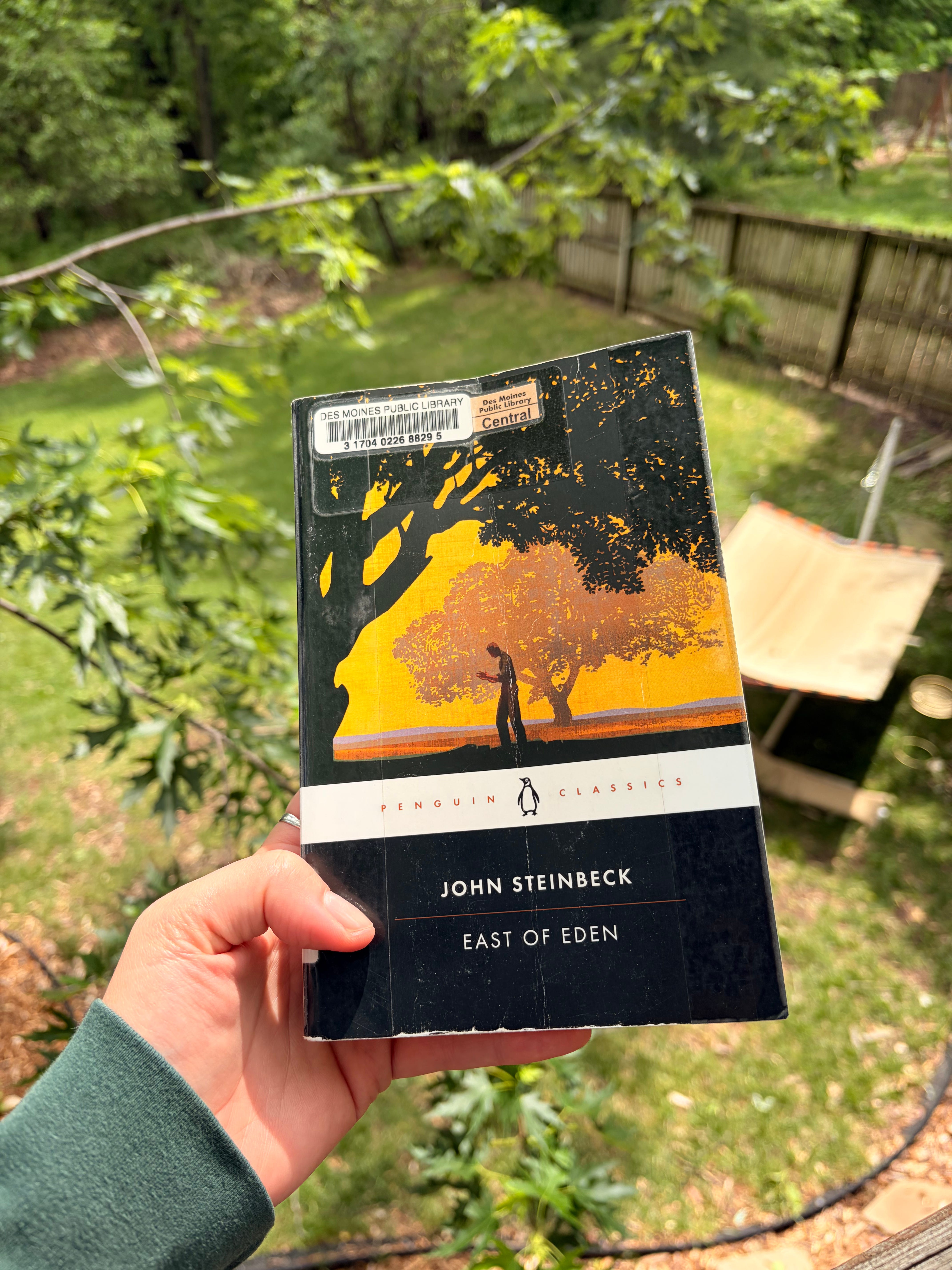
I recently checked out John Steinbeck’s East of Eden from the library, per the recommendation of a friend of a friend who is a librarian. The book had lots of holds on it (come to find out that is likely because Netflix is about to release a miniseries by the same name); it is 600 pages long, and I had to decide whether to plow through it in two weeks, or read as much as I can now and wait a few months to finish it. I chose the former, and I just finished it last night. I’ll share some of my initial reflections here, and I might sprinkle more insights into future posts, because God knows I’ve been seeing the world through East of Eden tinted glasses. Also Matt Crummy deserves to not have every other sentence he hears from me start with, “Oooo, there’s a story about [whatever we’re talking about, ex: lettuce] in East of Eden…”
High Five
First and foremost, I must tell you that John Steinbeck reached out from beyond the grave to give me a little pat on the back. He doesn’t (or his ghost doesn’t) know that he did this, but he did, and I will blow it out of proportion, indeed. I wrote a post a few weeks ago arguing that our current moment in time has a lot in common with the turn of the 20th century, specifically in how society is being shaped by technological advancements that are coming at us more rapidly than we can handle. Here’s how Steinbeck opened Part II of East of Eden:
You can see how this book has reached a great boundary that was called 1900. Another hundred years were ground up and churned, and what had happened was all muddied by the way folks wanted it to be—more rich and meaningful the farther back it was. In the books of some memories it was the best time that ever sloshed over the world—the old time, the gay time, sweet and simple, as though time were young and fearless. Old men who didn’t know whether they were going to stagger over the boundary of the century looked forward to it with distaste. For the world was changing, and sweetness was gone, and virtue too. Worry had crept on a corroding world, and what was lost—good manners, ease and beauty?…When our food and clothing and housing all are born in the complication of mass production, mass method is bound to get into our thinking and to eliminate all other thinking. In our time mass or collective production has entered our economics, our politics, and even our religion, so that some nations have substituted the idea collective for the idea God.
High five from Allie Crummy’s Brain to John Steinbeck’s ghost!!
Cain and Abel
If you’re not familiar with East of Eden (which, up until a couple weeks ago, I was not), Steinbeck is riffing off the story of Cain and Abel from the book of Genesis, alluding to other Genesis stories as well. Without divulging too much of my personal story, I’ll just say that I really identified with the two main Abel-based characters in the book. In fact, reading this book was like looking into a mirror at times, and I’ve already decided that it would be helpful for me to revisit this book in about ten years to see what of my own reflection peers back at me then. For now, Steinbeck has given me some rich insights to reflect on and compare to my own life, which I’ll save for my own private journaling.
I Don’t Wanna Fight
Steinbeck’s Abel-based characters brought something to the toxic dynamic with their Cains: they don’t like to fight. This isn’t to victim blame or to say that Abel deserved to get murdered because he didn’t want to fight back against Cain; but this is part of my own DNA, and it’s not always helpful. I don’t like to fight. I don’t like to argue. It doesn’t mean I’ll never do it, it just means that I avoid it wherever I can.A lot of that is because I’ve been in environments where there was a lot of fighting, but it was never fair. Manipulation, guilt tripping, damned-if-you-do-damned-if-you-don’t type scenarios were well established, and no outside force was going to change those dynamics, so of course I don’t like to fight. I chose other survival tactics, just like Steinbeck’s Abel-based characters, but now that I’m away from my Cains and am a full grown adult, I can see how this particular survival tactic is no longer serving me well. Because I don’t like to fight, I don’t always stand up for myself when I need to, and maybe I refrain from advocating for myself when it comes to new opportunities or things that I’m passionate about. Maybe it even keeps me from being fully myself. It is really draining for me to push back against people who test my boundaries, but this has become a very important muscle for me to exercise.
Villains/Victims
Along that same vein, I appreciated how Steinbeck handled all of the characters in this story. Each one is a human—no one is only good or only bad, no one is only a victim or only a villain. This is how I’ve experienced people in real life, and it was refreshing to read because it felt so different from the stories we’re telling ourselves currently. Give me 10 minutes on Instagram or TikTok, and I can show you four reasons why your partner is a narcissist, three ways that your boss is victimizing you, two accounts you should unfollow immediately, and one business you should never patronize again. Don’t mishear me: I’m not saying that I disagree with all of this. I’m on board with a good boycott, and there are plenty of people who need to be cancelled (as a matter of fact, I can think of a whole cabinet full of people who need to be cancelled), but nuanced human stories don’t fit into TikTok videos, and the bloodlust in the comments section isn’t making us any more human either. When everyone is either a victim or a villain, there is ultimately no accountability. Most villains once were victims, or at least they see themselves that way, therefore they can always blame someone who made them the way they are. Cain murdered Abel because he felt rejected, Trump lacks empathy because his environment rewarded him for it, perhaps a sexual abuser was the victim of sexual abuse, too. Et cetera.
Pain is real and should be honored and seen, but it can’t be used as an excuse for bad behavior in perpetuity. Steinbeck humanizes his characters not through false equivalency or moral relativism, but through the Hebrew word, timshel.
Timshel
My favorite scene in the book is when the two most upstanding characters confront an Abel character who is so wrapped up in licking his own wounds that he is unintentionally repeating the pattern of brokenness with his own sons. The three of them end up having a Bible study on the story of Cain and Abel in Genesis. One character does further research about the English translations of a particular word in Genesis 4:6-7 (KJV): “And the Lord said unto Cain, ‘Why art thou wroth? And why is thy countenance fallen? If thou doest well, shalt thou not be accepted? And if thou doest not well, sin lieth at the door. And unto thee shall be his desire, and thou shalt rule over him.’” The KJV translates the verb to imply a promise, “thou shalt rule over him”; the ASV’s translation implies a commandment, “do thou rule over it”; but the character looks into the Hebrew word and concludes that the better translation is “thou mayest”, which implies that Cain has a choice as to whether or not he will conquer sin.
This concept becomes the backbone for the rest of the book, and it’s a healthier way to see the world than legalism, determinism, or moral relativism, in my opinion. Timshel helps us to say: I got hurt and my default programming is leading me to ease my pain through unhealthy means or by hurting someone else. The pull is strong, but I still have agency over my own actions.
It’s true that not everyone feels pulled toward the same evils or vices. Cain’s instinct was to ease his pain by murdering his brother, and that is not a universal knee-jerk reaction. What is universally true is that none of us are always pulled to do the right thing or the best thing or the most compassionate thing or the most loving thing or the healthiest thing at all times, and therefore we can all relate to Cain on some level. And the good news for Steinbeck’s Cain-based character is that he can choose who he will be; he doesn’t have to be the bad guy. Thou mayest.
Such a good post! Love this.